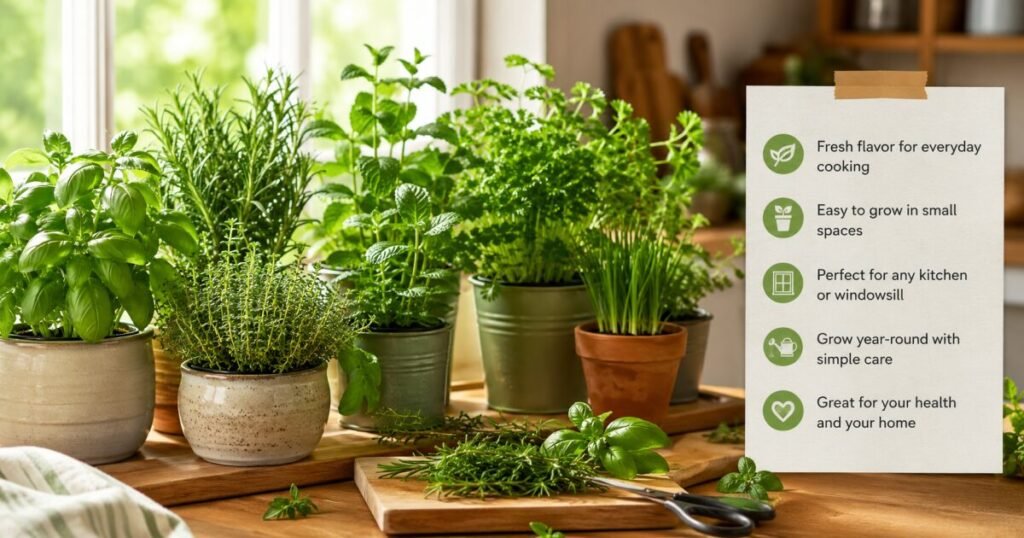
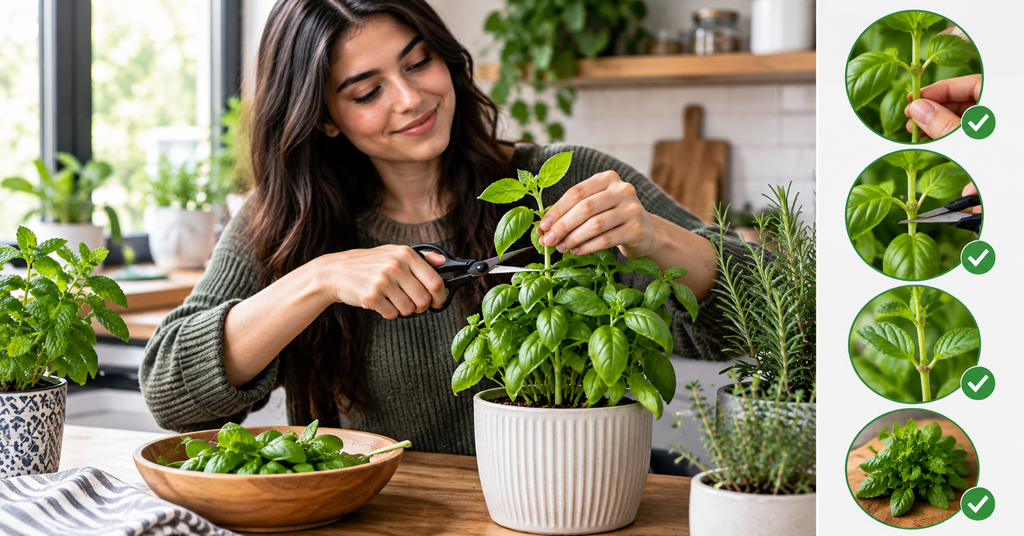
Harvesting indoor herbs correctly does more than give you fresh flavor for dinner. When you cut at the right place and take a reasonable amount, many herbs respond by producing more branches and leaves.
The basic method is simple: use clean, sharp scissors, harvest healthy stems when they are dry, cut above a leaf node when possible, and remove no more than one-third of the plant at a time. For cilantro, parsley, dill, and chives, harvest the outer stems near the base so the younger growth in the center can continue developing.
Quick Answer: How to Harvest Indoor Herbs
To harvest indoor herbs without damaging the plant:
- Wait until the plant has enough leafy growth to recover from cutting.
- Harvest when the leaves are dry, preferably in the morning after any moisture has evaporated.
- Use clean, sharp scissors or pruning snips.
- Cut basil, mint, oregano, thyme, and similar herbs just above a leaf node.
- Cut cilantro, parsley, and dill’s outer stems close to the base.
- Remove no more than one-third of the plant during one harvest.
- Leave the newest central growth intact.
- Harvest before flowering if you want the best leaf flavor.
Regular harvesting can encourage bushier growth, improve airflow, and help prevent indoor herbs from becoming tall and leggy.
If you’re still setting up your growing environment, choosing the right soil for indoor herbs can make a significant difference in how well plants recover after harvesting.
When to Harvest Indoor Herbs
The best harvest time depends on the herb, the plant part you want, and whether you plan to use the harvest fresh or preserve it.
For fresh leaves
Harvest leafy herbs when the plant is actively growing and has several healthy stems. Basil can usually be harvested once it has developed a few sets of true leaves. Cilantro, dill, and parsley should have enough outer stems to allow you to remove some without exposing the center of the plant.
For the strongest flavor, harvest leaves before the plant flowers. Flowering often shifts the plant’s energy away from leaf production and can change the flavor of some herbs. NC State Extension recommends harvesting foliage herbs before flowering, while flowers are generally harvested just as buds begin to open.
For drying
Harvest herbs for drying when they are clean and dry, before the heat of the day. Many leafy herbs have a concentrated aroma before flowering.
Woody herbs such as rosemary, thyme, oregano, and sage generally dry well. Basil can also be dried, but its leaves contain more moisture and may discolor or mold if they dry too slowly. For delicate herbs such as cilantro, dill, and parsley, freezing is often more useful than drying because it preserves more of their fresh character.
For flowers or seeds
If you are growing an herb for its flowers, harvest the flowers shortly after buds appear but before they are fully open. If you want seeds, allow the seed heads to mature and dry on the plant, then collect them before they split and scatter.
The No-Kill Harvesting Method
1. Check the plant first
Do not begin by cutting the tallest stem simply because it is easiest to reach. Look at the whole plant.
A healthy harvest-ready indoor herb usually has:
- Several sets of mature leaves.
- New growth near the tips or center.
- Firm, green stems.
- No widespread pest damage, wilting, or disease.
- Enough foliage left to continue photosynthesizing after the harvest.
If the plant is very small, pale, severely stretched, or recently transplanted, improve its growing conditions before taking a large harvest.
If your herbs are growing in a darker room, choosing suitable low-light herbs for an indoor garden can also help prevent weak, stretched growth.
2. Clean your scissors
Wipe scissors or snips with rubbing alcohol before harvesting, especially if you have recently handled a plant with pests, mildew, or damaged foliage. Clean tools reduce the chance of spreading disease between plants.
3. Choose healthy stems
Harvest green, vigorous stems and remove damaged or yellowing leaves separately. Avoid using diseased plant material for cooking or preservation.
For a large harvest, work around the plant instead of repeatedly cutting from one side. This helps maintain an even shape and allows light to reach the remaining leaves.
4. Cut in the right place
For branching herbs, make the cut just above a leaf node, the point where one or more leaves emerge from the stem. New shoots can develop from this area, producing a fuller plant.
Make a clean cut rather than crushing the stem. Dull scissors can tear plant tissue and leave ragged wounds.
5. Leave enough growth behind
A safe general rule is to harvest no more than one-third of the plant at one time. This gives the indoor herb enough leaves to continue producing energy and recovering from the cut.
For a weak or recently stressed plant, take less than one-third. You can always harvest again later.
Where to Cut Each Herb
| Herb | Where to cut | How much to remove | Important tip |
| Basil | Just above a pair of leaves or leaf node | Up to one-third | Remove flower buds early for continued leaf production |
| Mint | Just above a leaf node, or cut longer stems near the base | Up to one-third | Frequent trimming encourages bushier growth |
| Oregano | Above a leaf node or along green stems | Up to one-third | Harvest before flowering for strong leaf flavor |
| Thyme | Cut green, leafy tips; avoid repeatedly cutting into bare woody stems | Light to moderate harvest | Leave enough green growth for regrowth |
| Rosemary | Clip green sprigs, avoiding deep cuts into old woody stems | About one-third | Maintain the plant’s overall shape |
| Sage | Pinch individual leaves or cut green stems above a node | Light to moderate harvest | Avoid heavy cuts into old wood |
| Parsley | Cut the outer stems close to the base | A few stems at a time | Leave the center leaves growing |
| Cilantro | Cut outer stems near the soil line | Harvest selectively | Replant regularly because cilantro eventually bolts |
| Dill | Cut outer stems near the base | A few stems at a time | Harvest before seed production for leafy growth |
| Chives | Cut a clump 1–2 inches above the growing medium | Most of the clump is acceptable | New growth emerges from the center |
How to harvest basil
Basil is one of the easiest indoor herbs to harvest repeatedly. Instead of plucking individual leaves from random locations, cut the stem just above a pair of leaves.
That cut encourages the two buds at the node to grow into new branches. As a result, the plant becomes wider and more productive rather than developing one tall, bare stem.
When basil begins forming flower buds, pinch them off if your goal is culinary leaves. Once basil flowers heavily, leaf production and flavor may decline.
For more detailed growing and pruning information, see this guide on how to grow basil indoors.
How to harvest cilantro
Cilantro is frequently harvested incorrectly by removing only the largest leaves. A better approach is to cut the outer stems near the base, leaving the small central leaves untouched.
This lets the youngest growth continue developing. Harvesting the outer stems also gives you longer, more useful bunches for cooking.
Cilantro is a short-lived herb indoors. If it begins producing a tall central flower stalk, it is bolting. You can remove the flower stalk temporarily, but bolting usually means the plant is nearing the end of its leafy phase. Harvest what remains and start a succession planting.
For additional growing and harvesting guidance, see how to grow cilantro indoors.
How to harvest mint
Mint grows quickly and tolerates frequent cutting. Cut just above a leaf node to encourage branching. You can harvest individual stems for tea or cut back longer growth to maintain a compact shape.
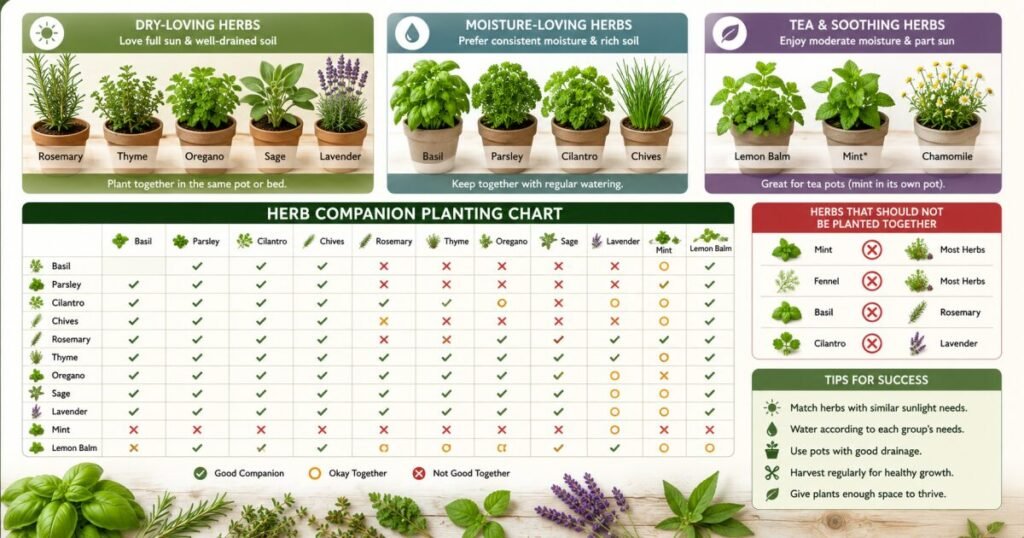
Because mint can grow aggressively, it is usually easier to manage in its own container. Do not allow the pot to remain waterlogged, even though mint generally prefers more moisture than rosemary or thyme.
How to harvest rosemary
Clip green rosemary sprigs from the tips or where smaller stems meet larger branches. Avoid making repeated heavy cuts into thick, leafless, woody sections because older wood may produce new growth slowly or not at all.
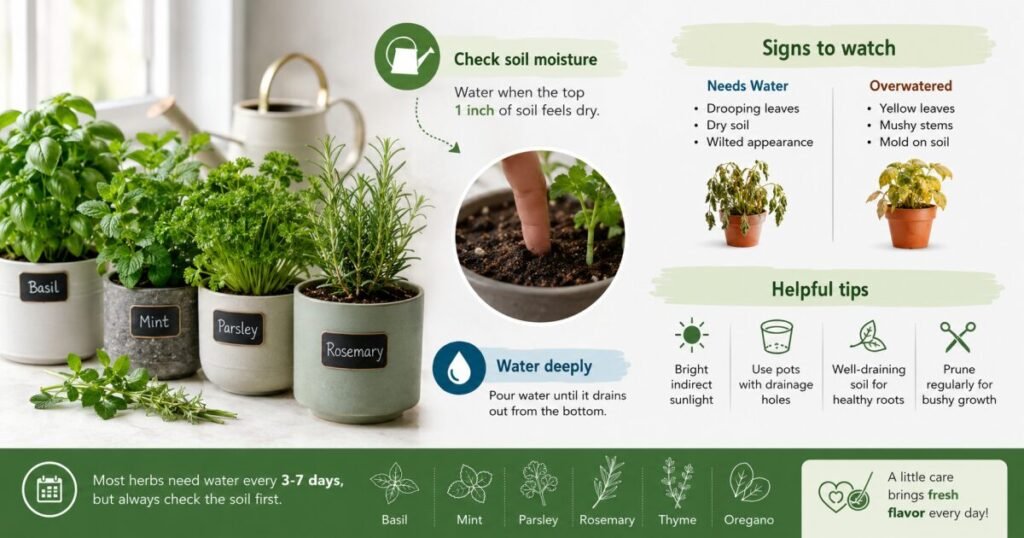
Rosemary prefers bright light, good drainage, and careful watering indoors. If the plant is already weak or dropping leaves, solve the root, light, or watering problem before harvesting heavily.
How to harvest thyme and oregano
For thyme and oregano, harvest the newest green growth rather than stripping leaves from old woody stems. You can cut a small bunch of stems at once, then remove the leaves in the kitchen.
Both herbs respond well to regular trimming. Oregano is often most flavorful just before flowering, while thyme can be harvested throughout active growth.
If you are growing oregano indoors, this guide to growing oregano covers its light, watering, soil, and pruning needs.
How to harvest parsley and dill
Cut the outside stems low, close to the base of the plant. Do not simply remove the top leaves from the stem, because these herbs produce new growth from the center rather than from the cut tip.
Leave the smallest inner leaves in place. This creates a continuous harvest pattern: older outside stems come out while younger central stems grow into the next harvest.
How to harvest chives
Gather several chive stems together and cut them about 1–2 inches above the soil or growing medium. Chives regrow from the base, so trimming the tops individually is less effective than cutting a section cleanly.
Avoid cutting every clump at once if the plant is small. Leave part of the plant growing so it can continue producing energy.
Soil-Grown vs. Hydroponic Herbs
Indoor herbs grown in potting mix and herbs grown in countertop hydroponic systems follow the same basic harvesting principles, but the surrounding care is different.
Healthy harvest indoor garden
For potted indoor herbs:
- Use a container with drainage holes.
- Check the moisture below the surface rather than watering on a fixed schedule.
- Keep the plant in bright light after harvesting.
- Empty excess water from the saucer.
- Avoid fertilizing immediately after every small harvest.
- Rotate the pot so growth remains even.
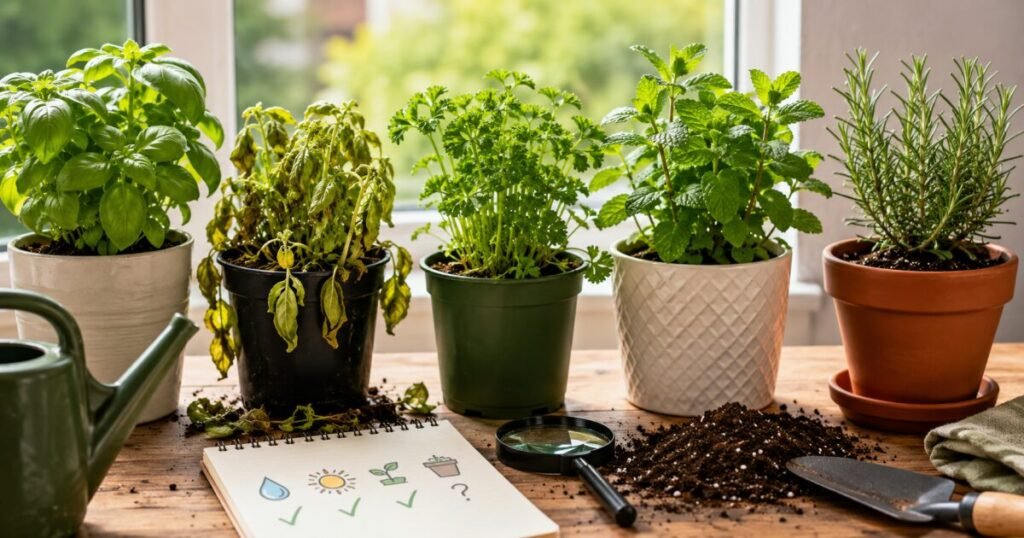
Harvesting removes leaves, but it does not correct poor light. If stems are long, thin, and leaning toward a window, the plant may need stronger light before it can produce compact new growth.
AeroGarden harvest indoor garden
In an AeroGarden or similar hydroponic system, prune tall herbs before they shade neighboring plants. AeroGarden recommends pruning at the leaf joint and removing no more than one-third of a plant at a time.
For a productive hydroponic harvest:
- Start with the tallest or most crowded plant.
- Cut just above a leaf joint where possible.
- Keep the light close enough to prevent excessive stretching, while leaving room for the plant to grow.
- Remove leaves that block light from shorter herbs.
- Do not allow harvested stems or leaves to fall into the water reservoir.
- Check that roots remain healthy and that the water and nutrients are maintained according to the system instructions.
If several herbs are growing in one unit, harvest the plants that are shading others first. This helps maintain a more balanced canopy.
What to Do After Harvesting
Harvesting is only half the process. How you handle the herbs afterward affects freshness and flavor.
For immediate use
Use fresh herbs as soon as practical. Remove damaged leaves and gently shake off debris. If washing is necessary, rinse quickly with cool water and dry thoroughly.
Wet leaves stored in a closed container can spoil quickly. For short-term storage, wrap sturdy herbs such as rosemary, thyme, oregano, and sage loosely in a paper towel and place them in a container or bag. Tender herbs such as basil and mint can be placed upright in a small glass of water and kept at room temperature.
For drying
To air-dry herbs:
- Harvest clean, dry stems.
- Remove damaged foliage.
- Tie small, loose bundles.
- Hang them upside down in a dry, dark, well-ventilated place.
- Strip the leaves from the stems once they are brittle.
- Store the dried leaves in an airtight container away from sunlight and heat.
Small bundles are important because thick, crowded bundles retain moisture and are more likely to mold. NC State Extension recommends drying herbs indoors in a dry area with good air circulation and storing them in tightly sealed containers once brittle.
For a more detailed preservation method, see how to dry herbs at home without losing flavor.
For freezing
Freezing works especially well for tender herbs that lose quality when dried.
You can:
- Chop herbs and freeze them in ice cube trays with water.
- Freeze chopped herbs in oil for sauces and cooking.
- Spread clean leaves on a tray, freeze them, and transfer them to an airtight container.
Frozen herbs are generally best for cooked dishes rather than garnishes because their texture softens after thawing.
Common Harvesting Mistakes
Taking individual leaves from everywhere
Plucking random leaves can leave an indoor plant uneven and leggy. Cut complete stems in a way that encourages branching.
Cutting too much at once
A large harvest may look satisfying, but removing most of the foliage can stall a small indoor plant. Stay near the one-third limit, especially when light levels are low.
Cutting every leaf node below
Cuts made too far below the lowest healthy leaves can leave a bare stem. On basil, mint, oregano, and similar herbs, keep the cut close above a node with healthy leaves.
Cutting cilantro or parsley from the top
These herbs are better harvested from the outside inward. Cut the entire outer stem near the base and preserve the center growth.
Harvesting wet leaves
Moisture increases the risk of spoilage during storage. Wait until water has dried from the foliage before harvesting for preservation.
Ignoring flowers
If you are growing herbs for leaves, flower buds are a signal to act. Pinch flower buds from basil and harvest leafy annuals such as cilantro and dill before they bolt. If you want edible or decorative flowers, harvest them at the early flowering stage instead.
Treating cannabis as a culinary herb
The secondary phrase “growing marijuana from seed to harvest indoor” describes a different plant and a different search intent from culinary herb harvesting. Cannabis cultivation may also be regulated differently depending on location. This guide focuses on legal culinary herbs such as basil, cilantro, mint, parsley, rosemary, thyme, and oregano; follow local laws and trusted specialist guidance for any cannabis-related question.
How Often Should You Harvest?
Harvest frequency depends on the herb’s growth rate, light, temperature, container size, and overall health.
A fast-growing basil or mint plant may need light trimming every few days. Rosemary and thyme generally grow more slowly and may need less frequent harvesting. The best schedule is not a fixed calendar—it is a repeatable check:
- Harvest when stems are long enough to cut cleanly.
- Take only what you need plus a small amount for preservation.
- Leave the center and newest leaves growing.
- Wait for visible regrowth before taking another large harvest.
- Reduce harvesting if the plant becomes pale, weak, or slow to recover.
Frequent light harvesting is usually better than rare, severe pruning.
If you’re unsure which herbs are appropriate for your particular light, space, and experience level, the Indoor Herb Finder can help you compare suitable options.
A Simple Weekly Harvest Routine
Use this five-minute routine to keep an indoor herb garden productive:
- Inspect each plant for pests, yellow leaves, flower buds, and overcrowding.
- Sanitize your scissors.
- Harvest the tallest or most mature stems first.
- Cut above nodes on branching herbs.
- Cut outer stems near the base on cilantro, parsley, and dill.
- Remove no more than one-third of each plant.
- Place the harvest in water, the refrigerator, freezer, or drying area depending on how you will use it.
- Return the plants to bright light and check their growing medium or reservoir.
If you are unsure which herbs are best for your available light, space, and growing method, use the Indoor Herb Finder to narrow down suitable choices before planting.
Frequently Asked Questions
How do you harvest herbs so they keep growing?
Use clean, sharp scissors and cut just above a leaf node on branching herbs such as basil, mint, oregano, and thyme. For cilantro, parsley, and dill, cut mature outer stems near the base and leave the center growth intact. Never remove more than about one-third of the plant during one harvest.
Do you pick herbs from the top or bottom?
It depends on the herb. For basil, mint, oregano, and similar branching herbs, pick or cut from the top just above a leaf node. Cut from the bottom for cilantro, parsley, and dill because their new growth develops from the center of the plant.
Can you harvest herbs after they flower?
Yes, but the best approach depends on your goal. You can harvest leaves after flowering, although flavor and texture may change. If you want flowers, harvest them shortly after the buds open. If the plant is producing seeds, allow seed heads to mature and dry before collecting them.
How do you harvest herbs and dry them?
Harvest clean, dry stems, preferably before flowering. Remove damaged leaves, tie the stems in small loose bundles, and hang them upside down in a dark, dry, well-ventilated place. Once the leaves are brittle, strip them from the stems and store them whole in an airtight container away from light and heat.
How do I know whether my indoor herb is ready to harvest?
Look for several healthy sets of leaves, firm stems, and active new growth. The plant should be large enough to lose a few stems without becoming bare. If it is pale, severely stretched, wilted, or recently transplanted, correct its growing conditions before taking a large harvest.
Why is my indoor herb growing tall instead of bushy?
The most common cause is insufficient light, although overcrowding and infrequent pruning can contribute. Move the plant closer to a bright window or provide suitable supplemental lighting. Then prune above leaf nodes to encourage side branches.
Should I wash herbs baefore drying them?
Wash only when necessary. If you rinse the herbs, remove excess water and allow the surface moisture to evaporate completely before drying. Wet herbs take longer to dry and may spoil or mold.
For more answers about indoor growing, watering, lighting, harvesting, and troubleshooting, you can also browse the site’s indoor herb gardening FAQs.
Final Takeaway
The safest way to harvest indoor herbs is to treat each cut as part of the plant’s future growth. Cut above nodes on branching herbs, harvest outer stems from cilantro and parsley, keep the center growing, and remove no more than one-third at a time.
With clean tools, adequate light, and regular light trimming, your indoor herb garden can provide repeated harvests instead of a single short-lived crop.