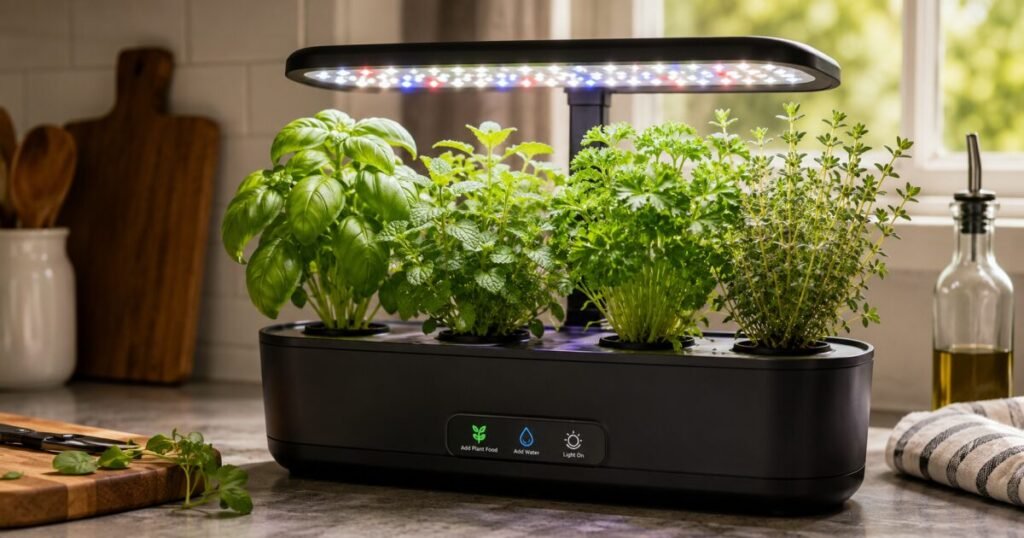
Quick Answer: The best indoor herb grower for most people is a self-contained hydroponic system with a built-in LED grow light, such as the AeroGarden Harvest or Click & Grow Smart Garden. These systems handle watering, lighting, and nutrients automatically, producing harvestable herbs like basil and mint in 3–4 weeks with minimal effort.
Key Takeaways
- An indoor herb grower is a self-contained system, usually hydroponic, that combines a water reservoir, plant pods, and a built-in LED grow light to grow herbs year-round without soil or sunlight.
- Hydroponic systems with a grow light consistently outperform windowsill pots because they deliver a controlled light schedule and steady nutrients, regardless of the weather or your home’s natural light.
- Pod capacity matters more than most buyers expect. A 3-pod system suits someone who cooks with only basil and mint; a 9–12 pod system suits a household that uses a wider variety of herbs.
- Proprietary pods lock you into one brand. AeroGarden pods can often be sourced from third-party sellers at a discount; Click & Grow requires its own branded pods.
- Light wattage is the single biggest predictor of herb quality. Look for at least 20W of full-spectrum LED for a 6-pod system; weaker lights produce leggy, less flavorful herbs.
- Most systems need refilling every 1–2 weeks and produce a first harvest within 3–4 weeks of planting.
What Is an Indoor Herb Grower?
An indoor herb grower is a compact, self-contained gardening system designed to grow culinary herbs indoors year-round, regardless of season, window access, or outdoor space. Most modern systems use hydroponics, meaning the plants grow in water enriched with nutrients instead of soil, combined with a built-in LED grow light that mimics the light spectrum plants need for photosynthesis.
This is different from simply putting a pot of basil on your windowsill. A dedicated indoor herb grower controls light intensity, light duration, and nutrient delivery automatically, which is why these systems tend to produce faster, more consistent, and more flavorful herbs than a plant relying on inconsistent natural light.
How Indoor Herb Growers Work
Most systems follow a similar basic structure, even though features vary by brand and price point.
- A water reservoir holds several days to a few weeks’ worth of water, depending on tank size.
- Grow pods or planting cups hold seeds (either pre-seeded by the manufacturer or filled with your own seeds) in a growing medium.
- A nutrient system delivers plant food either through liquid nutrients added to the water or through a pre-loaded “smart soil” that releases nutrients gradually.
- An LED grow light, usually mounted on an adjustable arm, provides full-spectrum light on an automatic timer, typically running 14–16 hours per day.
- A small water pump (in hydroponic models) circulates oxygenated, nutrient-rich water to the roots.
Types of Indoor Herb Growers
Not all indoor herb growers work the same way. Understanding the main categories helps you match a system to your cooking habits, budget, and tolerance for maintenance.
Hydroponic Systems (Liquid Nutrients)
These systems grow herbs directly in water mixed with liquid plant food, using a small pump to circulate it around the roots. AeroGarden is the best-known brand in this category.
Best for: People who want maximum growth speed and don’t mind an occasional nutrient top-up.
Smart Soil Systems
Instead of liquid hydroponics, these systems use a specialized growing medium, sometimes called “smart soil,” that gradually releases water and nutrients as the plant needs them. Click & Grow popularized this approach.
Best for: Complete beginners who want a true “set it and forget it” experience with no measuring or mixing.
Vertical and Tower Systems
Larger systems that stack multiple growing levels vertically, maximizing plant capacity in a smaller footprint. Brands like Gardyn and Lettuce Grow use this design.
Best for: Households that want to grow a wide mix of herbs, leafy greens, and small vegetables in one system.
App-Connected Systems
Newer entrants, such as LetPot and various touchscreen-controlled units, add smartphone app control, letting you adjust light schedules, monitor water levels, and track plant growth remotely.
Best for: Tech-oriented growers who like data and remote monitoring.
Comparing the Most Popular Indoor Herb Growers
| System | Type | Pod Capacity | Light Output | Best For |
| AeroGarden Harvest | Liquid hydroponic | 6 pods | 20W full-spectrum LED | Reliable all-around performance |
| AeroGarden Bounty Basic | Liquid hydroponic | 9 pods | 45W full-spectrum LED | Larger households, fruiting plants |
| Click & Grow Smart Garden 3 | Smart soil | 3 pods | Built-in LED, fixed cycle | Total beginners, small spaces |
| Click & Grow Smart Garden 9 | Smart soil | 9 pods | Full-spectrum LED bar, 16-hr timer | Beginners wanting more variety |
| LetPot LPH-SE | Liquid hydroponic, app-connected | 12 pods | App-adjustable LED | Mid-range value, app control |
| Gardyn / vertical tower systems | Liquid hydroponic, vertical | 20–30 pods | Multi-level full-spectrum LED | Large households, variety |
Specifications reflect manufacturer listings and widely reported user experience as of 2026 and may change as models are updated.
What to Look for in an Indoor Herb Grower
1. Light Wattage and Spectrum
Light is the single most important factor in how well your herbs grow. Look for a full-spectrum LED rated at least 20 watts for a 6-pod system; larger systems need proportionally more wattage. A weak or narrow-spectrum light produces “leggy” herbs, plants that stretch upward and grow thin and pale because they’re reaching for more light.
2. Pod Capacity
Think honestly about how many herbs you actually cook with regularly. A 3-pod system is plenty if you mainly use basil and mint. A household that cooks with a wide range, basil, parsley, cilantro, dill, thyme, chives, benefits from a 9- to 12-pod system.
3. Water Tank Size and Refill Frequency
Larger tanks mean less frequent maintenance. Compact systems typically need refilling every 1–2 weeks; larger vertical systems can go longer between refills but take up significantly more counter or floor space.
4. Nutrient System: Liquid vs. Smart Soil
Liquid hydroponic systems generally grow herbs slightly faster but require occasionally measuring and adding nutrient solution. Smart soil systems trade a small amount of speed for genuinely hands-off convenience, since nutrients are already built into the growing medium.
5. Pod Compatibility and Cost
This is an easy detail to overlook before buying, and it affects your long-term cost. Some brands, notably AeroGarden, allow pods from third-party sellers, which can meaningfully cut ongoing costs. Others, like Click & Grow, require brand-specific pods, which keeps things simple but limits your options and can raise your cost per herb over time.
6. Noise Level
Every hydroponic system uses a small water pump. Most run quietly, but some older or budget models produce a noticeable hum. If you plan to place the unit somewhere quiet, like a bedroom or a small studio apartment, checking user reviews for noise complaints is worth the extra five minutes.
Step-by-Step: How to Choose the Right Indoor Herb Grower
- List the herbs you actually cook with. This determines your ideal pod count more reliably than any spec sheet.
- Measure your available counter or shelf space. Compact 3-pod units fit almost anywhere; vertical towers need real floor space.
- Decide your maintenance tolerance. If you want true “set and forget,” lean toward smart soil systems. If you don’t mind occasional nutrient top-ups for slightly faster growth, hydroponic liquid systems work well too.
- Set a realistic budget, including ongoing pod or nutrient costs, not just the upfront device price.
- Check the light wattage against your pod count, not just the marketing description, since underpowered lights are the most common cause of disappointing results.
- Read recent user reviews for reliability issues, such as pump failures, mold in growing pods, or uneven lighting across pods.
Pros and Cons of Indoor Herb Growers
| Pros | Cons |
| Fresh herbs available year-round, regardless of season or window access | Higher upfront cost than a windowsill pot |
| Automated lighting and watering reduce user error | Ongoing pod or nutrient costs add up over time |
| Faster, more consistent growth than most soil-based windowsill setups | Proprietary pod systems can lock you into one brand |
| Compact designs fit small kitchens and apartments | Some systems have a noticeable footprint or hum |
| Great for beginners with no prior gardening experience | Limited to herb and small-plant varieties compared to a full garden |
Common Misconceptions About Indoor Herb Growers
“Any grow light will work as well as a dedicated system.”
General-purpose LED bulbs often lack the correct spectrum and intensity, leading to weaker, less flavorful herb growth compared to purpose-built full-spectrum systems.
“Hydroponic herbs taste worse than soil-grown herbs.”
In practice, freshly harvested hydroponic herbs are typically more aromatic and flavorful than store-bought herbs that have traveled and sat for days, since flavor compounds degrade quickly after cutting.
“You need gardening experience to succeed.”
Modern smart soil and hydroponic systems are specifically designed to remove guesswork, using preset light timers and automated nutrient delivery.
“Bigger systems are always better.”
A large vertical tower is wasted space and money if you only cook with one or two herbs regularly; matching pod count to actual usage matters more than maximizing capacity.
“Once it’s set up, you never need to check on it.”
Even the most automated systems still need periodic water refills, pod replacement, and occasional pruning to keep herbs productive.
Frequently Asked Questions
What is the best indoor herb grower for beginners?
Smart soil systems like the Click & Grow Smart Garden are generally considered the most beginner-friendly, since they eliminate liquid nutrient measuring and rely on preset automated lighting.
Do indoor herb growers with lights actually work better than a sunny windowsill?
Yes, generally. A dedicated grow light delivers a consistent light spectrum and duration regardless of weather, season, or window orientation, which windowsill herbs can’t reliably get, especially during winter months or in north-facing rooms.
How long does it take to grow herbs in an indoor herb grower?
Most systems produce herbs ready for a first light harvest within 3 to 4 weeks of planting, with basil, parsley, and mint typically among the fastest-growing options.
How often do I need to refill an indoor herb grower?
Most compact countertop systems need a water refill every 1 to 2 weeks, depending on tank size and how many plants are actively growing. Larger vertical systems can often go longer between refills.
Can indoor herb growers grow more than just herbs?
Many systems can also grow small vegetables like cherry tomatoes, peppers, and leafy lettuce, though higher-wattage lights (typically 45W or more) are usually needed to support fruiting plants successfully.