
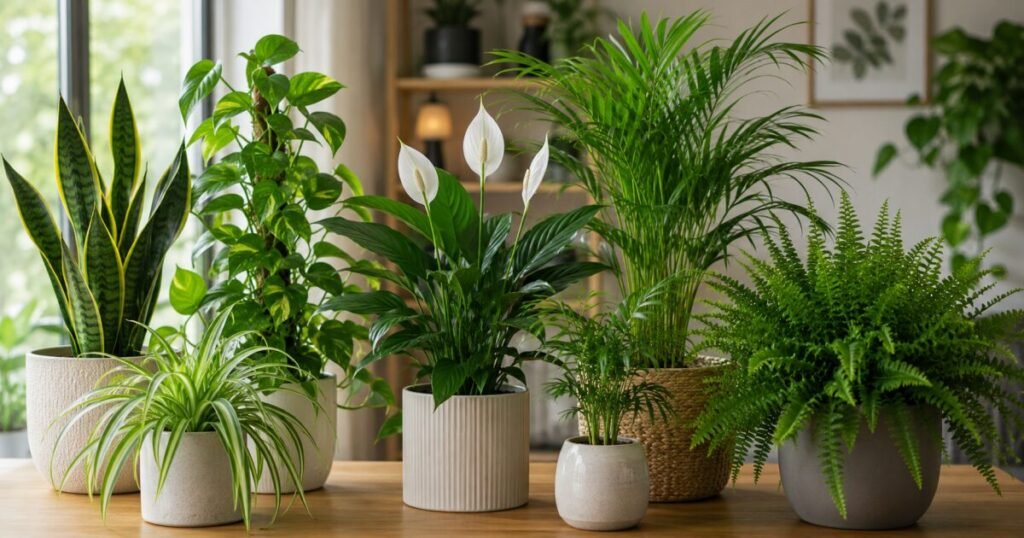
The best indoor plants for air quality include snake plant, spider plant, pothos, peace lily, and areca palm, all easy to maintain and shown in NASA’s 1989 Clean Air Study to remove trace amounts of common indoor pollutants like formaldehyde and benzene. Real-world impact is modest compared to good ventilation, but healthy plants still measurably improve comfort, humidity, and wellbeing indoors.
You’ve probably seen the claim that a few houseplants can “purify” your home’s air. It traces back to one NASA study from 1989, and the real story is more nuanced than most lists let on. This guide gives you the accurate version of that research, a genuinely useful plant list (including which ones are safe if you have pets), and the practical context nearly every competing article leaves out.
What the NASA Clean Air Study Actually Found
In 1989, NASA scientists tested 19 common houseplants inside small, sealed chambers to see how much they reduced concentrations of formaldehyde, benzene, and trichloroethylene over 24 hours. Some plants removed a meaningful share of pollutants under those sealed conditions; the Warneck dracaena removed roughly 50% of formaldehyde, for example.
That study was real, and it’s the source of nearly every “NASA-approved air purifying plants” list online. What most of those lists leave out: the chambers had almost no air exchange with the outside, which isn’t how a real room, apartment, or house works. A typical home swaps its indoor air with fresh outdoor air multiple times per hour through cracks, doors, windows, and HVAC systems something a sealed test chamber doesn’t do.
Independent research published after the original study (including a widely cited 2019 review by researchers Cummings and Waring) found that under realistic home ventilation rates, you’d need dozens to hundreds of plants per square meter of floor space to match the air-cleaning effect of a home’s normal air exchange. In other words, the handful of houseplants in your living room aren’t doing the heavy lifting your building’s airflow already is.
This doesn’t mean houseplants are useless for air quality; it means the effect in a real home is far smaller than viral lists suggest, and plants work best as one part of a broader approach, not a replacement for ventilation.
So Do Houseplants Actually Help Indoor Air Quality?
Yes, in smaller and more indirect ways than the popular narrative claims:
- Modest VOC uptake. Plants do take up some volatile organic compounds through their leaves and root-zone microorganisms, just at a scale that matters more in a sealed chamber than an average room.
- Humidity regulation. Transpiration adds moisture to dry indoor air, which can ease irritation from very dry heated air in winter.
- CO2 absorption during the day. Photosynthesis pulls in carbon dioxide, though the amount is small relative to what people exhale in an occupied room.
- Psychological and wellbeing benefits. Multiple studies on biophilic design link indoor greenery to lower reported stress and improved mood — a real, well-documented benefit that doesn’t depend on the air-purification claim at all.
The Best Indoor Plants for Air Quality (and Why)
| Plant | Pollutants Studied | Light Needs | Care Level | Pet-Safe? |
| Snake plant (Sansevieria) | Formaldehyde, benzene, xylene | Low to bright, indirect | Very easy | No — mildly toxic to cats/dogs |
| Spider plant (Chlorophytum comosum) | Formaldehyde, xylene | Bright, indirect | Very easy | Yes |
| Golden pothos (Epipremnum aureum) | Formaldehyde, benzene, xylene | Low to bright, indirect | Very easy | No — toxic to cats/dogs |
| Peace lily (Spathiphyllum) | Formaldehyde, benzene, trichloroethylene, ammonia | Low to medium, indirect | Easy | No — toxic to cats/dogs |
| Areca palm (Dypsis lutescens) | Formaldehyde, xylene, toluene | Bright, indirect | Moderate | Yes |
| Boston fern (Nephrolepis exaltata) | Formaldehyde, xylene | Medium, indirect, high humidity | Moderate | Yes |
| Bamboo palm (Chamaedorea seifrizii) | Formaldehyde, benzene, trichloroethylene | Low to medium, indirect | Moderate | Yes |
| Rubber plant (Ficus elastica) | Formaldehyde | Bright, indirect | Easy | No — mildly toxic to cats/dogs |
| Chinese evergreen (Aglaonema) | Formaldehyde, benzene | Low light tolerant | Very easy | No — toxic to cats/dogs |
Beginner picks: spider plant and areca palm both pet-safe, low-maintenance, and forgiving of inconsistent watering.
Best Pet-Safe Indoor Plants for Air Quality
If you have cats or dogs, several popular “NASA list” plants (snake plant, pothos, peace lily) are actually mildly to moderately toxic if chewed, which none of the standard air-purifying-plant lists flag clearly enough. These are non-toxic alternatives that still made NASA’s original testing list:
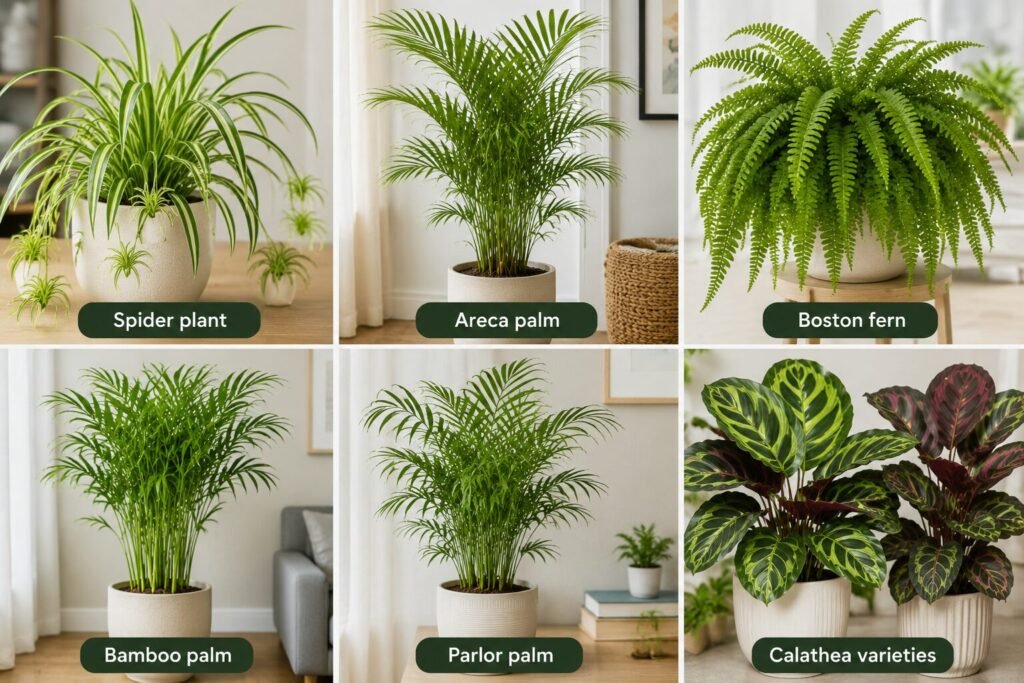
Always double-check a specific plant and pet combination against the ASPCA’s toxic and non-toxic plant database before bringing anything new into a home with pets, since toxicity varies by exact species and cultivar.
How to Actually Improve Indoor Air Quality (Beyond Plants)
Houseplants work best as a supplement to these higher-impact steps, not a substitute for them:
- Ventilate regularly. Opening windows when weather allows exchanges stale indoor air for fresh outdoor air far faster than any number of plants.
- Use exhaust fans in kitchens and bathrooms to remove cooking byproducts and excess moisture at the source.
- Address pollution at the source. Low-VOC paints, fewer synthetic air fresheners, and proper ventilation of new furniture reduce what needs to be filtered in the first place.
- Consider a HEPA air purifier for particulates (dust, pollen, pet dander, smoke) that plants don’t meaningfully remove.
- Keep humidity in a healthy range (usually 30–50%); both very dry and very humid air can cause their own irritation and mold issues.
Common Misconceptions About Air-Purifying Plants
“A few houseplants will noticeably clean my room’s air.”
The chamber conditions in the original NASA study don’t reflect real home ventilation rates; the effect at typical houseplant density is much smaller than viral lists imply.
“More plants always means better air quality.”
Overwatered plants and their soil can actually increase mold spore counts and humidity beyond a healthy range, which can worsen air quality for allergy- or asthma-prone people.
Read more: How Often to Water Herbs? Indoor, Outdoor, and Potted Herb Watering Guide
“NASA-tested plants are all safe to have around pets.”
Several of the most-cited plants on the original list (snake plant, pothos, peace lily) are toxic to cats and dogs if chewed.
“Air-purifying plants replace the need for ventilation.”
No amount of houseplants substitutes for fresh air exchange, especially in tightly sealed modern homes.
Pros and Cons of Using Houseplants for Air Quality
Pros
- Adds humidity to dry indoor air
- Genuine, well-documented mood and stress benefits
- Low ongoing cost compared to air purifiers
- No electricity required
- Improves a room’s overall aesthetic and comfort
Cons
- Real-world pollutant removal is far smaller than popular lists suggest
- Overwatered soil can increase mold spores and humidity problems
- Several popular “clean air” plants are toxic to pets
- Doesn’t address particulates like dust, pollen, or pet dander the way a HEPA filter does
- Requires ongoing care to stay healthy enough to provide any benefit at all
Key Takeaways
- The NASA Clean Air Study is real, but its sealed-chamber results don’t scale directly to how a real home’s air actually moves.
- Houseplants offer modest air-quality benefits alongside real, well-documented mood and humidity benefits, not a replacement for ventilation.
- Several of the most commonly recommended “air-purifying” plants (snake plant, pothos, peace lily) are toxic to cats and dogs.
- Pet-safe alternatives that were part of NASA’s original testing include spider plant, areca palm, Boston fern, and bamboo palm.
- Ventilation, source control, and (if needed) a HEPA air purifier do more for measurable indoor air quality than houseplants alone.
FAQs
Do NASA-approved plants really purify indoor air?
The plants were shown to remove pollutants inside small sealed test chambers, but independent research shows that effect doesn’t scale to a real home’s air exchange rate, so the practical impact of a typical number of houseplants is much smaller than popular lists suggest.
Which indoor air-purifying plants are safe for cats and dogs?
Spider plant, areca palm, Boston fern, bamboo palm, parlor palm, and most Calathea varieties are non-toxic pet-safe options that were also included in NASA’s original plant testing.
How many houseplants do I need to notice a difference in air quality?
There’s no agreed-upon number for a typical home; realistic research suggests you’d need far more plants than most people keep indoors to match the effect of normal home ventilation, so a handful of plants should be treated as a comfort and wellbeing addition rather than a measurable air-cleaning system.
Can houseplants make indoor air quality worse?
Yes, if overwatered consistently, damp soil can increase mold spore counts and humidity beyond a healthy range, which can be a problem for people with allergies or asthma.
Are air purifiers or houseplants better for indoor air quality?
They serve different purposes. HEPA air purifiers are far more effective at removing particulates like dust, pollen, and pet dander, while houseplants add humidity and well-being benefits; using both together covers more ground than either alone.