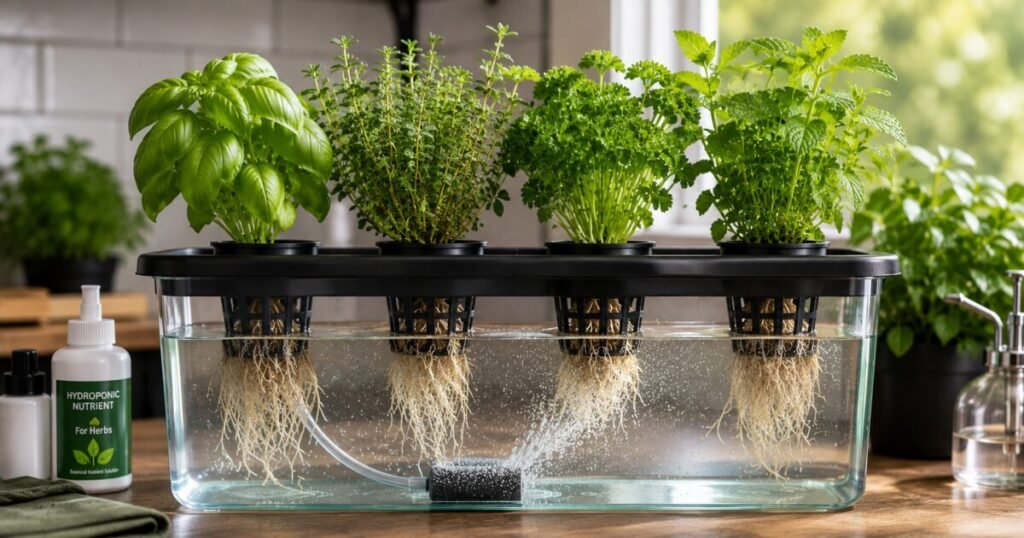
Quick Answer: An indoor hydroponic herb garden grows herbs in nutrient-rich water instead of soil, using a system like Deep Water Culture, Kratky, or a wick setup to deliver water, nutrients, and oxygen directly to the roots. This typically produces faster growth and higher yields than soil-based indoor herb gardening, and it works year-round on a windowsill, countertop, or dedicated grow shelf.
Key Takeaways
- Hydroponic growing replaces soil with a nutrient-rich water solution, delivering water, minerals, and oxygen directly to plant roots.
- The easiest beginner systems are the wick system (no electricity needed) and the Kratky method (passive, no pump required); Deep Water Culture (DWC) is the next step up and remains simple while producing faster growth.
- Herbs generally grow faster in hydroponics than in soil, since nutrients are immediately available rather than needing to be broken down and absorbed gradually.
- Two numbers matter more than anything else: pH (ideal range 5.5–6.5 for most herbs) and EC/nutrient concentration (roughly 1.2–1.8 mS/cm for leafy herbs). Getting these wrong is the single most common reason hydroponic herbs fail.
- A basic DIY hydroponic herb garden can be built for $30–$100; ready-made countertop kits with lights typically start around $50–$150.
- Algae growth, root rot, and nutrient lockout are the three most common problems, and all three are preventable with basic maintenance habits.
What Is a Hydroponic Herb Garden?
A hydroponic herb garden grows herbs without soil, instead suspending or supporting the roots in a nutrient-rich water solution. The word “hydroponic” comes from Greek roots meaning “water” and “labor,” a fitting description of a growing method where water does the work that soil normally handles.
In a hydroponic system, the plant’s roots get direct access to dissolved minerals, oxygen, and water all at once, instead of extracting them gradually from soil particles. This direct access is the main reason hydroponic herbs often grow faster and more vigorously than the same herbs grown in potting soil under similar light conditions.
How Is This Different From a Regular Indoor Herb Garden?
A standard indoor herb garden still uses potting soil in a pot, just placed indoors instead of outside. A hydroponic indoor herb garden replaces that soil entirely with water and an inert growing medium (like rockwool, clay pebbles, or coconut coir) that simply holds the plant in place while its roots grow into the nutrient solution below.
| Feature | Soil-Based Indoor Herb Garden | Hydroponic Indoor Herb Garden |
| Growing medium | Potting soil | Water plus an inert support medium |
| Nutrient delivery | Gradual, from soil breakdown | Immediate, dissolved in water |
| Watering | Manual, as soil dries out | Reservoir-based, often lower frequency |
| Growth speed | Standard | Often faster |
| Pest risk | Soil-borne pests possible | Lower soil-pest risk, but algae/root issues possible |
| Setup complexity | Simple | Slightly more involved, especially active systems |
How Does Hydroponic Growing Work?
Every hydroponic system delivers the same three essentials to plant roots: water, dissolved nutrients, and oxygen. What differs between system types is exactly how and how often that delivery happens.
- Water carries dissolved nutrients (nitrogen, phosphorus, potassium, calcium, magnesium, and trace minerals) directly to the root zone.
- An inert growing medium, such as rockwool cubes, clay pebbles, or coconut coir, physically supports the plant without adding its own nutrients, unlike soil.
- Oxygen reaches the roots either through an air pump and air stone (active systems), a natural air gap as water levels drop (passive systems like Kratky), or fine misting (aeroponic systems).
Because the plant doesn’t have to expend energy breaking down organic matter in soil to access nutrients, more of its energy goes directly into growth, which is the core reason hydroponic herbs tend to mature and produce usable leaves faster than their soil-grown counterparts.
Types of Hydroponic Systems for Herbs
Not every hydroponic system is a good fit for a home herb garden. Here’s how the main types compare, from simplest to most advanced.
Wick System
A wick, usually cotton or nylon, draws nutrient solution up from a reservoir into the growing medium through capillary action, the same principle that pulls water up a paper towel.
Pros:
No pump, no electricity, extremely low cost.
Cons:
Slow nutrient delivery; not well-suited to larger or thirstier herbs like basil once mature.
Best for:
Absolute beginners, small herbs, classroom or kids’ projects.
Kratky Method
A passive system where plant roots sit partially submerged in a sealed container of nutrient solution. As the plant consumes water, the solution level drops, naturally creating an air gap that oxygenates the roots without any pump.
Pros:
No electricity or moving parts at all; very low cost; simple to maintain.
Cons:
Best suited to shorter growing cycles; not ideal for long-term, continuously harvested herbs.
Best for:
Beginners, small windowsill setups, low-maintenance growing.
Deep Water Culture (DWC)
Plant roots hang directly into an oxygenated nutrient reservoir, supported by a net pot at the surface. An air pump and air stone continuously oxygenate the water.
Pros:
Simple to build, relatively inexpensive, produces reliably fast growth.
Cons:
Requires electricity for the air pump; needs regular nutrient and pH monitoring.
Best for:
Most home herb growers who want a straightforward, active system.
Nutrient Film Technique (NFT)
A thin, continuously flowing film of nutrient solution runs through a sloped channel, bathing the roots as it passes.
Pros:
Water-efficient, works well for smaller, fast-growing herbs.
Cons:
A pump failure can dry out roots within hours; requires careful slope and flow calibration.
Best for:
More experienced growers comfortable with closer monitoring.
Ebb and Flow (Flood and Drain)
A growing tray periodically floods with nutrient solution, then drains back into a reservoir on a timer.
Pros:
Good root oxygenation between flood cycles; flexible for multiple plants in one tray.
Cons:
More moving parts (timer, pump, drainage) than DWC or Kratky.
Best for:
Growers ready to manage a slightly more complex system for a larger herb collection.
Aeroponic Systems
Roots hang in an enclosed chamber and receive nutrients through a fine mist, sprayed at timed intervals.
Pros:
Excellent oxygenation, often the fastest growth of any method.
Cons:
Highest technical complexity; a misting failure can damage roots quickly.
Best for: Advanced hobbyists, not typically a first system.
Comparing Hydroponic System Types for Home Herb Growing
| System | Equipment Needed | Maintenance Level | Cost to Start | Best For |
| Wick | Wick, container, medium | Very low | $15–$30 | Absolute beginners |
| Kratky | Sealed container, medium | Low | $15–$40 | Beginners, small spaces |
| DWC | Container, air pump, air stone | Moderate | $30–$100 | Most home growers |
| NFT | Channels, pump, reservoir | Moderate to high | $50–$150 | Growers wanting efficiency |
| Ebb and Flow | Tray, pump, timer, reservoir | Moderate to high | $60–$200 | Larger herb collections |
| Aeroponic | Misting chamber, pump, timer | High | $100–$300+ | Advanced hobbyists |
How to Build a Simple DIY Hydroponic Herb Garden (DWC Method)
Deep Water Culture strikes the best balance between simplicity and performance for most home herb growers, which is why it’s the method described step by step below.
What You’ll Need
- A food-grade container (a 5-gallon bucket or bin works well)
- Net pots that fit into holes cut in the lid
- An inert growing medium: clay pebbles, rockwool, or coconut coir plugs
- An air pump and air stone, sized for your container volume
- A hydroponic nutrient solution formulated for leafy greens and herbs
- A pH testing kit and pH up/down adjusting solution
- Herb seedlings or pre-soaked seeds
Step-by-Step Setup
- Cut holes in the container lid sized to hold your net pots snugly without them falling through.
- Fill the container with water, ideally filtered or dechlorinated, and mix in your nutrient solution according to the product’s instructions.
- Test and adjust pH to land in the 5.5–6.5 range most herbs prefer, using pH-up or pH-down solution as needed.
- Place the air stone in the bottom of the reservoir, connected to the air pump outside the container, and turn it on before adding plants.
- Set seedlings into net pots surrounded by your chosen growing medium, positioned so roots can reach down into the water below.
- Position the system under adequate light, either a bright south-facing window or a full-spectrum LED grow light rated for at least 20–40 watts for a small herb setup.
- Check pH and nutrient levels every few days, and top off the reservoir with fresh nutrient solution as the water level drops from plant use and evaporation.
Nutrient Solution, pH, and EC: What You Actually Need to Know
This is the section most beginner guides oversimplify, and it’s also where most hydroponic herb gardens actually run into trouble.
pH: Why It Matters More Than You’d Expect
pH measures how acidic or alkaline your nutrient solution is, on a scale of 0 to 14. Most culinary herbs grow best in a pH range of about 5.5 to 6.5. Outside that range, plants can struggle to absorb specific nutrients even when those nutrients are present in the water, a problem called nutrient lockout. Test pH every few days with paper strips or a digital meter, and adjust gradually with small amounts of pH-up or pH-down solution rather than large corrections all at once.
EC: Measuring Nutrient Strength
Electrical conductivity (EC) measures the concentration of dissolved nutrients in your solution, expressed in millisiemens per centimeter (mS/cm). For most leafy herbs, a target range of roughly 1.2 to 1.8 mS/cm works well. Too low, and plants grow slowly from insufficient nutrition; too high, and roots can actually be damaged or “burned” by an overly concentrated solution.
Choosing a Nutrient Solution
Most home growers use a pre-mixed hydroponic nutrient solution rather than building one from scratch. Look for a formula labeled for leafy greens or herbs, and follow the manufacturer’s mixing instructions closely, since concentration needs vary by brand.
Best Herbs for Hydroponic Growing
| Herb | Suitability | Notes |
| Basil | Excellent | Fast-growing, one of the most popular hydroponic herbs |
| Mint | Excellent | Vigorous grower; give it its own reservoir to avoid crowding others |
| Chives | Very good | Compact, well-suited to smaller systems |
| Cilantro | Good | Grows quickly but bolts (flowers) faster in warm conditions |
| Parsley | Good | Slower-growing but reliable |
| Dill | Good | Benefits from a system with reliable support for taller growth |
| Thyme | Moderate | Prefers slightly less constant moisture than leafy herbs |
| Rosemary | Moderate | Slower to establish hydroponically; benefits from an active, well-oxygenated system like DWC |
Common Problems and How to Fix Them
Algae Growth
Algae thrives when light reaches the nutrient solution directly. Use opaque containers and keep reservoirs covered to block light from the water itself, not just the plants.
Root Rot
Roots sitting in stagnant, poorly oxygenated water are prone to rot. Make sure your air pump and air stone are functioning consistently, and avoid letting water temperatures climb too high, which reduces dissolved oxygen.
Nutrient Lockout
Yellowing leaves or stunted growth despite adequate nutrients usually points to a pH problem rather than a nutrient deficiency. Test and correct pH before adding more nutrient solution.
Pump or Power Failure
Active systems like DWC and NFT depend on continuous power. A brief outage usually isn’t catastrophic for DWC, since the reservoir still holds oxygenated water for a while, but NFT systems can dry out roots within hours if the pump stops.
Pros and Cons of Indoor Hydroponic Herb Garden
| Pros | Cons |
| Faster growth than soil-based indoor herbs | Requires more attention to pH and nutrient balance |
| No soil mess; works well on counters and shelves | Ongoing cost for nutrient solution |
| Fewer soil-borne pests and diseases | Active systems depend on electricity |
| Works year-round regardless of season | Initial learning curve for beginners |
| Scalable, from a $30 DIY bucket to a full grow wall | Algae and root rot are real risks without proper maintenance |
Common Misconceptions About Hydroponic Herb Gardens
“Hydroponic herbs taste blander than soil-grown ones.”
In practice, freshly harvested hydroponic herbs are often more aromatic than store-bought herbs that traveled and sat for days, since flavor compounds degrade quickly after cutting, regardless of growing method.
“You need expensive equipment to start.”
A basic wick or Kratky system can be built for under $40 using a plastic container and basic hardware store supplies.
“Hydroponics is pesticide-free by default.”
Hydroponic systems reduce soil-borne pests, but herbs can still attract aphids, spider mites, or fungus gnats, especially if grown near other houseplants.
“All hydroponic systems need constant electricity.”
Wick systems and the Kratky method are entirely passive and require no power at all.
“Hydroponic setups are maintenance-free.”
Even simple systems need periodic pH checks, nutrient top-offs, and reservoir cleaning to prevent algae and salt buildup.
Frequently Asked Questions
What is the easiest hydroponic system for growing herbs indoors?
The wick system and the Kratky method are the easiest for beginners, since neither requires a pump, electricity, or ongoing calibration. Deep Water Culture is the next easiest step up and offers faster growth with only modest added complexity.
Do hydroponic herbs grow faster than herbs grown in soil?
Generally, yes. Because nutrients are immediately available in dissolved form rather than needing to be broken down from soil, hydroponic herbs typically reach harvestable size faster than the same herbs grown in potting soil under similar light conditions.
What pH should I keep my hydroponic herb garden at?
Most culinary herbs grow best in a pH range of 5.5 to 6.5. Testing every few days and adjusting gradually with pH-up or pH-down solution helps prevent nutrient lockout, a common cause of yellowing leaves and stunted growth.
Can I build a hydroponic herb garden without buying a kit?
Yes. A basic DIY Deep Water Culture system can be built for roughly $30 to $100 using a food-grade container, net pots, an air pump, growing medium, and a hydroponic nutrient solution.
Why do my hydroponic herb leaves keep turning yellow?
Yellowing is most often caused by a pH imbalance that prevents proper nutrient absorption, though it can also indicate low nutrient concentration or insufficient oxygen at the roots. Testing pH first is the fastest way to narrow down the cause.