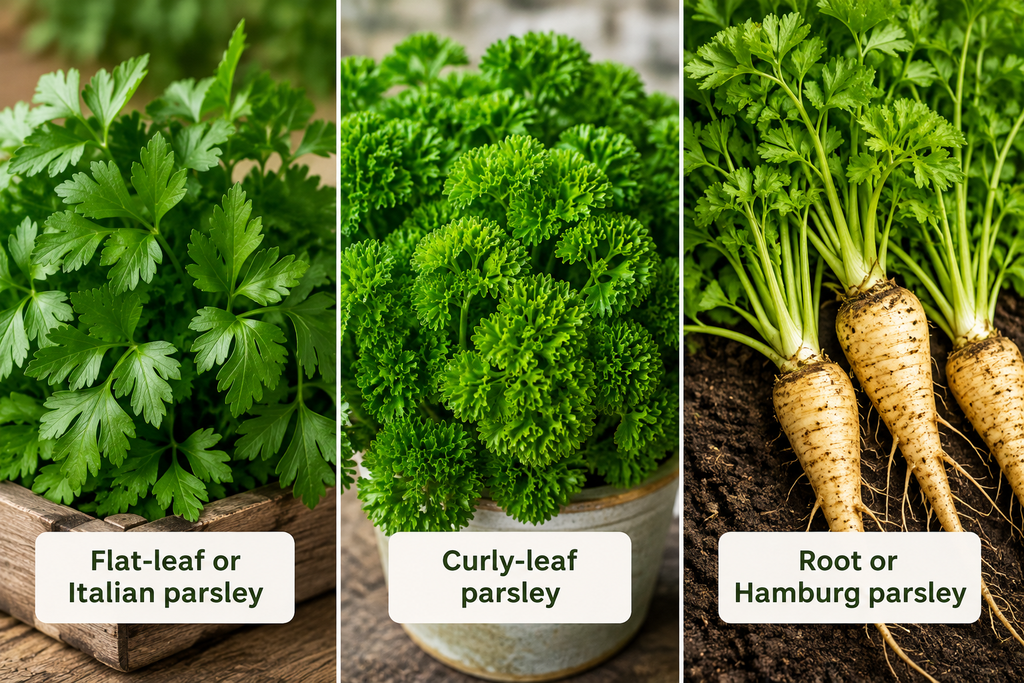
The main types of parsley are flat-leaf parsley, curly parsley, and root parsley. Flat-leaf parsley is usually the best choice for cooking because it has a stronger, fresher flavor and root parsley is grown mainly for its parsnip-like root.
Whether you want parsley for an indoor herb garden, fresh salads, soups, or decorative planting, choosing the right variety makes a noticeable difference.
What Are the Main Types of Parsley?
Parsley belongs to the carrot family, Apiaceae, and its botanical name is Petroselinum crispum. Although it is officially a biennial plant, it is commonly grown as an annual because gardeners usually harvest it before it flowers in its second year.
| Type of parsley | Appearance | Flavor | Best uses |
| Flat-leaf or Italian parsley | Broad, flat, dark-green leaves | Fresh, aromatic, slightly peppery | Sauces, salads, soups, pasta, tabbouleh |
| Curly-leaf parsley | Tightly curled, ruffled leaves | Mild, grassy, sometimes slightly bitter | Garnishes, salads, soups, container gardens |
| Root or Hamburg parsley | Parsnip-like white root and parsley leaves | Nutty root; leaves are more pronounced | Soups, stews, roasted vegetables |
1. Flat-Leaf Parsley
Flat-leaf parsley is also called Italian parsley, plain-leaf parsley, or Petroselinum crispum var. neapolitanum. It has broad, flat leaves that can resemble cilantro, although the two herbs have different aromas and flavors.
It is generally considered the most flavorful type of parsley. Its fresh, slightly peppery taste stands up well in both raw and cooked dishes, making it the variety most often recommended when a recipe simply says “parsley.”
Best uses for Italian parsley
Use flat-leaf parsley in:
- Tabbouleh and other herb-heavy salads.
- Chimichurri and salsa verde.
- Pasta, grain bowls, and roasted vegetables.
- Soups, stews, sauces, and stuffings.
- Garlic butter, lemon sauces, and marinades.
- Homemade pesto or herb blends.
The stems are edible and can be particularly flavorful. Chop tender stems with the leaves, or save thicker stems to add flavor to stocks and broths.
Is flat-leaf parsley the best-tasting parsley?
For most savory recipes, flat-leaf parsley is the best-tasting variety because its flavor is more noticeable and aromatic than curly parsley. It is especially useful when parsley is an important ingredient rather than just a finishing decoration.
2. Curly-Leaf Parsley
Curly parsley is also known as common parsley, garden parsley, or French parsley. Its tightly ruffled leaves give it a distinctive texture and decorative appearance.
Curly parsley has a milder flavor than flat-leaf parsley. Depending on the plant and how fresh it is, the taste can be grassy, lightly sweet, or slightly bitter. Its dense curls can also make it more difficult to wash and chop evenly.
Best uses for curly parsley
Curly parsley works well in:
- Garnishes for soups, stews, and roasted dishes.
- Salads and potato salads.
- Omelets and savory breakfast dishes.
- Stuffings and meatballs.
- Herb butter and breadcrumbs.
- Indoor pots and decorative herb gardens.
Curly parsley should not be dismissed as merely decorative. It is fully edible and can add freshness, color, and texture to food. However, you may need to use more of it than flat-leaf parsley if you want its flavor to stand out.
Why grow curly parsley?
Curly parsley is a useful choice for gardeners because its compact, textured growth looks attractive in containers, borders, and small indoor herb gardens. It can also serve as a host plant for black swallowtail butterfly caterpillars.libguides.nybg+1
3. Root or Hamburg Parsley
Root parsley, also called Hamburg parsley, German parsley, or turnip-rooted parsley, is grown primarily for its enlarged white root. The root resembles a small parsnip and can be cooked in much the same way.
Its flavor falls somewhere between parsley and celeriac, with a mild, earthy, slightly nutty character. The leaves are edible too, although they are less commonly used than the root.
Best uses for root parsley
Try the root in:
- Soups and stews.
- Roasted vegetable dishes.
- Mashed root vegetables.
- Vegetable stocks.
- Braised dishes.
- European-style recipes that call for root vegetables.
Root parsley needs deep, loose soil so the root can develop properly. It is therefore less convenient for a shallow indoor pot than flat-leaf or curly parsley.
Parsley Leaf Types vs. Parsley Root Types
When people search for “types of parsley leaves,” they are usually comparing flat-leaf and curly parsley. These are grown mainly for their foliage.
Root parsley is different because the main harvest is underground.
Leaf parsley
- Harvested for leaves and tender stems.
- Suitable for pots and indoor herb gardens.
- Usually used fresh or added to cooked dishes.
- Includes flat-leaf and curly varieties.
Root parsley
- Harvested mainly for its enlarged root.
- Requires deeper soil and more growing space.
- Used like a parsnip or celeriac.
- The leaves can also be harvested, but they are not the primary crop.
Which Type of Parsley Should You Choose?
Choose parsley based on how you plan to use it.
| If you want to… | Choose… |
| Add strong flavor to recipes | Flat-leaf parsley |
| Make tabbouleh or chimichurri | Flat-leaf parsley |
| Garnish plates and serving dishes | Curly parsley |
| Grow an attractive compact herb | Curly parsley |
| Harvest an edible root | Hamburg parsley |
| Grow parsley indoors in a regular pot | Flat-leaf or curly parsley |
| Use parsley in soups and sauces | Flat-leaf parsley |
| Grow a less common European vegetable | Hamburg parsley |
For most home cooks, flat-leaf parsley is the most versatile first choice. If you have room for two plants, grow flat-leaf parsley for cooking and curly parsley for garnishes and visual interest.
What Does Parsley Taste Like?
Parsley generally tastes fresh, green, and lightly peppery, but the flavor depends on the variety.
- Flat-leaf parsley: More aromatic, bright, peppery, and herbaceous.
- Curly parsley: Milder, grassier, and sometimes slightly bitter.
- Hamburg parsley root: Mild, earthy, and nutty.
Freshness also affects flavor. Parsley that has wilted or yellowed may taste duller and more bitter than recently harvested leaves.
Parsley is often used at the end of cooking because heat can reduce its fresh character. Add some early for background flavor and a final handful just before serving for brightness.
Is Parsley a Perennial?
Parsley is a biennial, not a true perennial. It usually produces leaves during its first year, then flowers and sets seed during its second year before dying.
In mild climates, parsley may survive through winter and appear to grow for more than one season. In colder areas, it is often grown as an annual or overwintered in a protected location.
Once parsley begins to bolt, the leaves may become tougher or less appealing. You can allow the flowers to develop for pollinators and seed production, or replace the plant with a new one for tender leaves.
How to Grow Parsley Indoors
Flat-leaf and curly parsley are both suitable for indoor herb gardens.
Basic growing requirements
- Place the pot near a bright window or under a grow light.
- Use a container with drainage holes.
- Choose fertile, well-drained potting mix.
- Keep the soil evenly moist but not waterlogged.
- Harvest the outer stems first so the plant can continue producing.
- Leave the central growing point intact.
Parsley seeds can be slow to germinate. Soaking them before sowing may improve germination, but patience is still important. Established plants are often the quickest option for an indoor garden.
Read more: How to Grow Parsley: A Complete Guide for Indoors, Pots, and Outdoors
How to harvest parsley
Cut outer stems close to the base rather than removing only the leaf tips. Regular harvesting encourages the plant to produce new growth. For the best flavor, harvest in the morning or whenever the leaves look crisp and hydrated.
Parsley Benefits
Parsley is a nutrient-rich herb that provides vitamins A, C, and K, along with smaller amounts of B vitamins, calcium, iron, fiber, and antioxidant compounds. (source)
Because parsley is normally eaten in relatively small portions, it should be viewed as a nutritious addition to meals rather than a substitute for a varied diet. Its most practical benefits are its ability to add flavor, freshness, color, and nutrients without requiring much salt, sugar, or fat.
How to Store Fresh Parsley
The best way to store fresh parsley is to keep it cool and hydrated without allowing the leaves to sit in stagnant water.
Refrigerator method
- Remove damaged or yellow leaves.
- Trim the bottom of the stems.
- Place the parsley upright in a jar with a small amount of water.
- Loosely cover the leaves with a reusable bag.
- Refrigerate and replace the water when it becomes cloudy.
You can also wrap parsley loosely in a slightly damp paper towel and place it in a container or reusable storage bag. Avoid washing it until you are ready to use it unless you dry it thoroughly first.
Can You Freeze Parsley?
Yes, you can freeze parsley. Freezing is especially useful for flat-leaf parsley when you plan to use it in soups, sauces, stews, and other cooked dishes.
Easy parsley freezing method
- Wash and dry the parsley thoroughly.
- Chop the leaves and tender stems.
- Place the chopped parsley in an ice-cube tray.
- Cover with water or olive oil.
- Freeze until solid.
- Transfer the cubes to a labeled freezer bag.
Frozen parsley will not retain the same crisp texture as fresh parsley, so it is best used in cooked dishes rather than as a raw garnish.
How to Dry Parsley
Drying works best when parsley is dried quickly and stored away from light, heat, and moisture. Curly parsley is often dried for seasoning, although either leaf type can be preserved this way.
Oven-drying method
- Wash the parsley and dry it completely.
- Remove thick stems.
- Spread the leaves in a thin layer on a baking sheet.
- Dry at the lowest practical oven temperature.
- Check frequently until the leaves are crisp.
- Crumble and store in an airtight container.
Do not store dried parsley until it is fully moisture-free. Any remaining moisture can reduce its shelf life.
Dried parsley has a softer flavor than fresh parsley, so it is best used in soups, sauces, casseroles, marinades, and seasoning blends.
What Is the Best Parsley Substitute?
The best substitute depends on the recipe and whether parsley is being used for flavor, color, or garnish.
| Substitute | Best for |
| Cilantro | Fresh herb sauces, salads, and some garnishes |
| Chervil | Delicate sauces and salads |
| Fresh celery leaves | Soups, stocks, and savory dishes |
| Basil | Pesto, pasta, and Mediterranean recipes |
| Arugula | Tabbouleh-style salads and herb-heavy dishes |
| Dried parsley | Cooked recipes when fresh parsley is unavailable |
Cilantro is not always a good replacement for parsley because it has a much stronger and more distinctive flavor. If you dislike cilantro, use celery leaves, chervil, or a small amount of fresh basil instead.
Frequently Asked Questions
What are the different types of parsley?
The three commonly recognized types are curly-leaf parsley, flat-leaf or Italian parsley, and root or Hamburg parsley. Curly and flat-leaf parsley are grown mainly for their leaves, while Hamburg parsley is grown mainly for its root.
What is the difference between Italian parsley and regular parsley?
“Italian parsley” usually means flat-leaf parsley. “Regular parsley” can be ambiguous because some people use it to mean curly parsley, while others use it as a general term for parsley. Check the leaf shape: flat leaves indicate Italian parsley, while tightly ruffled leaves indicate curly parsley.
Which parsley is best for cooking?
Flat-leaf parsley is usually the best all-purpose cooking variety because it has a stronger, more aromatic flavor. Curly parsley is also suitable, particularly for garnishes, salads, stuffings, and recipes where a milder flavor is preferred.
What is the best variety of parsley to grow?
For most gardeners, flat-leaf parsley is the best variety to grow because it is versatile in the kitchen. Curly parsley is a good choice for compact containers and decorative planting, while Hamburg parsley is best for gardeners who want to harvest a root crop.
Can you eat parsley stems?
Yes. Tender parsley stems are edible and flavorful, especially on flat-leaf parsley. Chop them with the leaves or use thicker stems to flavor stocks, soups, and sauces.
Does parsley grow well in containers?
Yes. Parsley grows well in containers as long as the pot has drainage, the soil remains evenly moist, and the plant receives sufficient light. Flat-leaf and curly varieties are particularly suitable for balconies, windowsills, and indoor herb gardens.
Final Choice
If you want just one parsley plant, choose flat-leaf Italian parsley for its flavor and versatility. Choose curly parsley when garnish, texture, or compact growth matters most, and grow Hamburg parsley when you want an edible root as well as leafy greens.